- Home
- Troubleshooting
- Electric Services
- A/ C Services
- Quote
- Specials
- Products
- Trane Products>
- About Trane
- Trane XL20i
- Trane XL16i
- Trane XL15i
- Trane XR15
- Trane XR13
- Trane XB14
- Trane XB13
- Trane Mini Splits
- Trane Products By Model Numbers
- Trane Filter Size Guide
- Trane Hyperion Air Handler
- Trane 2/4TEE Air Handler
- Trane ComfortLink Remote Thermostat
- Trane XL950 Zoning System Thermostat
- Trane CleanEffects
- Trane Commercial Financing
- Trane Extended Warranties
- About Trane
- Amana
- Goodman Products>
- About Goodman
- Goodman Air Conditioners>
- Goodman Heat Pumps>
- Goodman Mini Splits>
- Goodman Package Units>
- Goodman Air Filtration>
- Goodman DMH900 Whole-House HEPA Air Cleaner
- Goodman GHEPA/GDMHEPA Air Cleaner
- Goodman AHMAC Media Air Cleaner
- Goodman GGM Grille-Mount Electronic Air Cleaner
- Goodman GSASD High Efficiency Air Cleaner
- Goodman G13MU Media Air Cleaner
- Goodman GMU Media Air Cleaner
- Goodman GRAM Media Air Cleaner
- Goodman GBB High-Efficiency Media Air Cleaner
- Goodman G1EAC Electronic Air Cleaner
- Goodman DMH900 Whole-House HEPA Air Cleaner
- Goodman Air Handlers>
- Goodman ComfortNet™ Communicating Control System
- Goodman Warranty Search
- Goodman Extended Warranties
- About Goodman
- Rheem Products>
- Rheem Pool Heaters
- Rheem Prestige Series: Single Stage
- Rheem Prestige Series: 2-Stage
- Rheem Prestige Series: 2-Stage Serial Communicating
- Rheem RANL Classic Series: Single Stage
- Rheem RAPM Classic Series: Single Stage
- Rheem 13AJM Value Series: Single Stage
- Rheem 14AJM Value Series: Single Stage
- Rheem RHPN Air Handler
- Rheem RHKL Air Handler
- Rheem RHLL Air Handler
- Rheem RHSL Air Handler
- Rheem RHAL Air Handler
- Rheem RHBL Air Handler
- Rheem Electronic Air Cleaner
- Rheem Filter Size Guide
- Rheem Extended Warranties
- Rheem Pool Heaters
- Bryant Products>
- Lennox Products>
- Maytag Products
- Frigidaire Products
- Daiken Mini Splits>
- Honeywell Thermostats>
- Nest Thermostat
- Ecobee Thermostat
- Used Condensers
- Trane Products>
- A/C Blog
- Air Quality
- Videos
- Videos 2
- Comments
- Schedule Service
- Mission Statement
- Eco-Friendly
- Answers
- Careers
- Bonita Springs
- Naples
- Company Resources
- Survey
- NATE Certified
- Questions & Answers
- Frequently Asked Questions
- History of Air Conditioning Brands
- Customer Portal
- Match +5%
- N.A.T.E Exam Review
- HVAC Quick Tips
How Clean Is The Air In Your Home?

Homeowners are often not aware of the invisible and extremely important component to their comfort and health:
AIR QUALITY. The air you are inhaling in many instances, in your own home, has in it pollutants, gases (radon, carbon monoxide, etc.) and mold toxins, more detrimental to your health than the air outside, resulting in the Sick Home Syndrome. What is happening in most cases is that when windows and doors are closed, the house cannot breathe and rid itself of these elements.
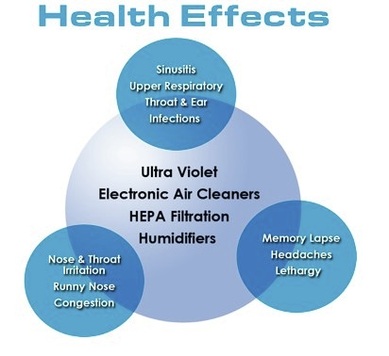
Sick Home Syndrome Air quality ranks high on the list of government environmental concerns. The air in many homes contains harmful pollutants that are invisible, odorless and not readily detected. These substances can be more detrimental than the air outside and can cause health problems such as irritated eyes and nose, headaches, dizziness, tiredness, infections and respiratory diseases.
Indoor pollution sources that release gases or particles into the air are the primary cause of indoor air quality problems in homes. Inadequate ventilation can increase indoor pollutant levels by not bringing in enough outdoor air to dilute emissions from indoor sources and by not carrying indoor air pollutants out of the home. High temperature and humidity levels can also increase concentrations of some pollutants.
If too little outdoor air enters a home, pollutants can accumulate to levels that can pose health and comfort problems. Unless they are built with special mechanical means of ventilation, homes that are designed and constructed to minimize the amount of outdoor air that can "leak" into and out of the home may have higher pollutant levels than other homes.
In a process known as infiltration, outdoor air flows into the house through openings, joints, and cracks in walls, floors, and ceilings, and around windows and doors. In natural ventilation, air moves through opened windows and doors. The rate at which outdoor air replaces indoor air is described as the air exchange rate. When there is little infiltration, natural ventilation, or mechanical ventilation, the air exchange rate is low and pollutant levels can increase.
3920 Progress Ave. | Naples, FL 34104 | 239-596-5855
AC Lic #CAC1813838 Elec Lic # EC0002113
